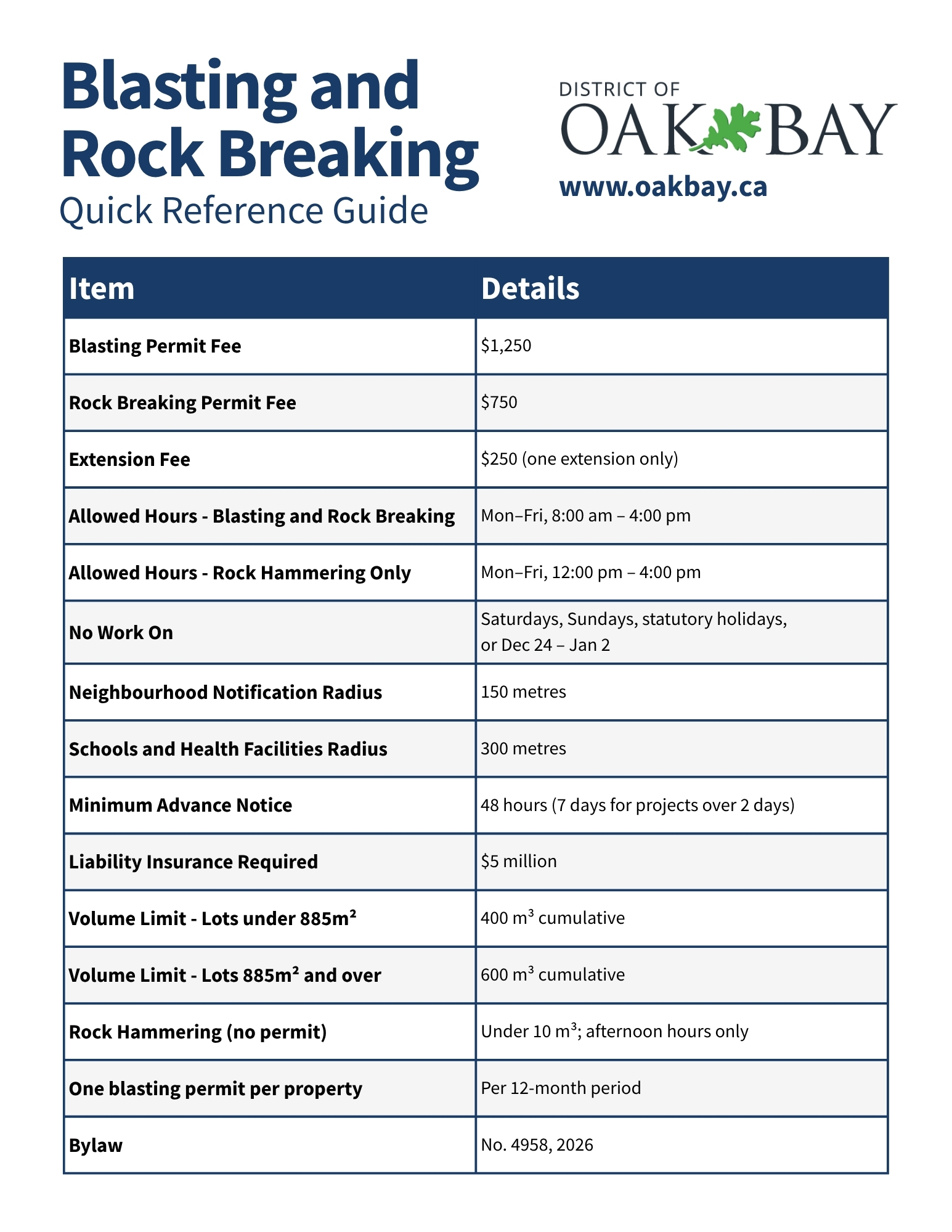
Before you apply for a blasting or rock breaking permit with the District of Oak Bay, take time to review the content below on what work needs a permit and specific regulations for blasting and rock breaking.
Do I Need to Apply for a Permit?
What Needs a Permit
Blasting and rock breaking in excess of 10m3 requires a permit. In residential zones blasting and rock breaking is only allowed for:
Building
Home, garage, laneway home, accessory dwelling unit (ADU), driveway or parking area, all with a valid building permit.
Accessory Buildings
When embedding structure in the slope reduces exposed foundation walls or visible mass from the street. Examples include a workshop or garden studio.
Utility installation or connection
- Water
- Sewer
- Gas
- Electrical
Swimming Pools
If the building official is satisfied that blasting or rock breaking reduces visual and noise impact for neighbours.
Other work includes
Required safety work certified by a geotechnical engineer or minor terrain changes to support landscaping or improve site usability (only if work doesn’t substantially alter natural grade).
What Doesn't Need a Permit
- Rock breaking that removes less than 10 m³ of material (roughly the volume of a standard garden shed)
- Removing boulders that are entirely separate from bedrock, by any volume
- Work specifically authorized by provincial or federal law
- Emergency work — if the Building Official confirms in writing that urgent work is needed to address an immediate threat to life, safety, or infrastructure
What Can Be Done
How Much Rock Can Be Removed?
On residential lots (zoning R-1 through R-5 and equivalent CD zones), the bylaw caps the total amount of rock any property owner can remove during a construction project. The limits do not apply to commercial, mixed-use or other residential projects.
Lots UNDER 885 Square Meters
400 cubic metres, maximum total volume
Lots OVER 885 Square Meters
600 cubic metres, maximum total volume
These limits are cumulative. If the District has records of rock previously removed on your property, that volume counts toward your limit. If no records exist, no adjustment is made.
The Building Official has some discretion to adjust the limit based on unusual site conditions or the specifics of an active building permit. Volume limits do not apply to road or utility work covered by approved subdivision drawings.
What Time of Day Can I Blast or Rock Break?
Blasting hours are shorter than typical construction hours (7:00 a.m. – 7:00 p.m.) to reduce disruption to neighbourhoods, including those working from home and night shifts. Work is not permitted on weekends (Saturday and Sunday), statutory holidays and from December 24 to January 2. On-site rock crushing or grinding is completely prohibited at any time.
Blasting and Rock Breaking
Monday through Friday
8:00 a.m. – 4:00 p.m.
Rock Hammering (Hoe-Ramming)
Monday through Friday
12:00 p.m. – 4:00 p.m.
Applying for a Permit
After checking if the work is permitted on your property, you will need to apply for a permit. The District reviews all blasting and rock breaking applications to confirm that the work is permitted on your property, that all required documents are in order, and that neighbours will be properly notified. Once you’ve confirmed work is permitted, and that you have applied for a building permit if needed, follow these steps:
Gather your required documents
Each permit type requires a building permit where rock removal is connected to construction of a building, alongside a signed Letter of Undertaking releasing the District from liability.
To help expedite the process, ensure you also have the following documents ready:

Blasting Permit
Use of explosives or chemicals to move or fracture rock
- WorkSafe BC blasting certificate
- $5 million liability insurance
- Pre-blast surveys of nearby properties
- Blasting plan / control measures
- Topographic survey (engineer or B.C.L.S.)
- Arborist report if trees are nearby
- Context map showing heritage buildings
- Road/sidewalk closure plan (if needed)
Rock Breaking Permit
Drilling, hydraulic breaking, or splitting — no explosives
- $5 million liability insurance
- Letter of undertaking from owner
- Topographic survey (engineer or B.C.L.S.)
- Arborist report if trees are nearby
- Context map showing heritage buildings
- Road/sidewalk closure plan (if needed)
- No blasting certificate required
- No pre-blast survey required
Complete and Submit Your Application
Complete your PDF application and submit it to inspections@oakbay.ca. You will also need to pay the relevant permit fee:
Blasting: $1,250
Rock Breaking: $750
What Comes Next?
Staff will then confirm that your application is complete, verify your documents for compliance with the bylaw and issue the permit. Once issued, a blasting permit expiry date depends on your property size:
- Lots under 885 square meters: Permit expires after 20 business days
- Lots over 885 square meters: Permit expires after 30 business days
Rock breaking permits expire after 30 business days. You can apply for one extension at a cost of $250.
Notifying Neighbours
Once your permit has been issued, you will need to:
- Post the site summary at least one week before work begins
- Send written notices to all property owners within 150 metres at least 48 hours before work begins
- Notify senior administrators at schools and health facilities within 300 metres. The blaster must also give schools and health facilities two hours of warning before each individual blast.
- Notify the District when work is complete
Additional Resources
Quick Reference guide